Authentic Orthodoxy vs Spiritual Pride: Nationalism, Secularization, and Real Christian Life Today
The text emphasizes that true Orthodoxy is not ideological or performative but lived in humility, love, repentance, and real relationships within family, parish, and daily life. In an age of artificial intelligence and digital spirituality, it calls for a return to embodied faith, unity of the Body of Christ, and practical Christian love as the only authentic witness in today’s globalized and secularized world.
3 min lezen
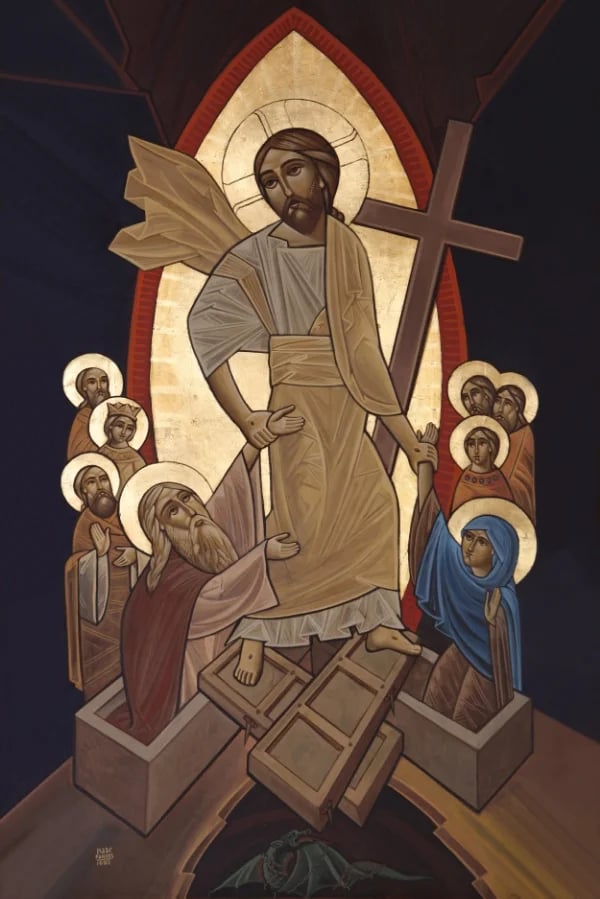
Here are the seven “fakes” (dragons) that he calls on us to “kill” within ourselves:
Nationalistic: when faith is replaced by loyalty to the nation.
Aesthetic: fascination with the external splendor of rituals without inner life.
Intellectual: the transformation of Orthodoxy into a dry academic theory.
Political: using the Church as an instrument of ideology.
Psychological: seeking only personal comfort or “exoticism” in religion.
Fanatical: blind adherence to the letter and external forms (zealotry).
Gnostic: the creation of an “elitist” Orthodoxy for the chosen few.
The author insists that Real Orthodoxy is not a complex system of rules, but a simple life in love with God and neighbor, based on the real experience of the saints, not on ideological constructs.
Commentary on the author's opinion
I largely agree with this text and with the diagnosis it offers. The danger of pretended piety, spiritual pride, and “playing at holiness” is real and destructive. Authentic spiritual life is indeed simple and is measured by love, repentance, and the reality of life in Christ, not by imaginary images we create about ourselves.
That said, I would add a few remarks from my own experience of serving in Europe.
The problem is that these “viruses of false Orthodoxy” today are not confined to one place but are present in almost all Local Churches. Serving in parishes under different jurisdictions, I have seen that the Serbian, Greek, and especially the Russian church environments are often affected by the virus of nationalist Orthodoxy. Clustering along national lines and the practical fragmentation of the unity of the Body of Christ has, sadly, become almost normal. This is one of the most painful distortions, because it is often disguised as “faithfulness to tradition,” while in reality it replaces catholicity with ethnicity.
The author speaks about the secular processes of the so-called Western world. But today it is difficult to speak of any “conditional West” as the sole source of secularization. In Moscow, which many consider the center of “saving Orthodoxy,” there is sometimes no less confusion and substitution of meanings than in Amsterdam, which is often labeled “decadent.” Personally, I fundamentally disagree with that stereotype and label, which do not correspond to reality. In Amsterdam I have met deeply faithful people who have devoted their entire lives to serving the Lord. Secularization and spiritual distortion have long since become global. This is not about geography but about the state of the human heart.
One more thought. In the age of artificial intelligence, words, texts, and even very beautiful articles have in many ways lost their weight. One can write anything and create any image of spirituality. Therefore it becomes especially clear today that only one authentic witness remains: to live in love in concrete reality. In one’s own home. In one’s own family. In one’s own parish. In one’s own circle. Where a person truly bears responsibility and cannot hide behind an image.
Authentic Orthodoxy is not found in ideological schemes or in self-images. It is always embodied. It is tested in relationships, faithfulness, humility, and the ability to love the specific people around us. Everything else may turn out to be just another illusion of piety.
Father Andriy (Todosiychuk)
On the Slaying of the Seven Fake Orthodoxies
Archpriest Andrew Phillips
In nearly fifty years of association with Orthodoxy, I have seen how the devil can fake everything. This is because he is himself a fake: a fake god – though many still worship him. As ‘a liar and the father of lies’ (Jn 8, 44), he can most certainly fake every human activity, including faith. He can use faith to create fake faith. I have seen this in the seven types of fake Orthodoxy, the deviations which he creates and which I have observed. The first three are primitive deviations, the next two are psychological deviations and the last two belong to the more complex realm of delusional deviations. All of them have one thing in common: they provide no spiritual food at all and so the souls that follow these fakes die of the spiritual famine which they leave in their wake.
full text of the author's article at the link
In recent years, many voices have spoken about the crisis of authenticity in Orthodox Christian life. Some speak about secularization, others about spiritual pride. Yet the deeper problem may be more universal and closer to home.
De Orthodoxe Parochie van de Geboorte van de Moeder Gods en de Heilige Adelbert
KvK 99887282 · RSIN 869173625
Oecumenisch Patriarchaat van Constantinopel
Contacts
priest: Andriy (Todosiychuk)
number: 06-23882565 (WhatsApp/ Telegram)
e-mail: fr.andriy@orthodox-alkmaar.nl
Our social media
Church Service Venues
©2026 The Orthodox Parish of the Nativity Theotokos in Alkmaar and Saint Adalbert of Egmond. All rights reserved.
Monastery of Saint Adalbert
Vennewatersweg 25, 1935 AR
Egmond-Binnen