A Guide to Reading the Psalter for the Departed
Reading the Psalter is an important spiritual effort. First, the prayers help the departed souls reach the Kingdom of God and ease their journey through the toll-houses before God’s judgment. Second, praying for a loved one brings comfort and healing to the living, offering consolation and peace.
Why Read It?
Reading the Psalter is an important spiritual effort. First, the prayers help the departed souls reach the Kingdom of God and ease their journey through the toll-houses before God’s judgment. Second, praying for a loved one brings comfort and healing to the living, offering consolation and peace.
Can Laypeople Read It?
Yes, any baptized person may read the Psalter. It’s a devout and deeply rooted Church tradition.
Should You Stand or Sit?
At home, you may sit. What matters is reverence, focus, and respect toward the prayer.
How Much Should You Read Daily?
It depends on your preference, one to three kathismata (divisions) daily. Or, you can agree with others to take turns reading: each person reads one kathisma, so the entire Psalter is completed daily by a group.
The most important thing is not the number of psalms, but love and sincere desire to help the departed soul. Even one kathisma read with tears and faith can bring great relief on the soul’s posthumous journey.
When and How Often to Read
First three days after death: The soul is still close to this world and needs prayers.
Special days: On the 3rd, 7th, 9th, and 40th days after passing, it is customary to request memorial services, liturgies, and submit prayer notes at church.
Thereafter: Read annually—on the anniversary of death and on general memorial Saturdays.
When Not to Read
During Bright Week (from Holy Thursday to Thomas Sunday), the Psalter for the departed is not read, except the celebratory psalms 112–117 and the Great Hallelujah (Psalm 135). This reflects the joy of the Resurrection and victory over death, when prayers of forgiveness aren’t read for the departed, since all the baptized are considered cleansed of sins during these days.
Is Blessing Required?
For ordinary reading for repose, no blessing is needed. But if you intend to undertake it as a regular or long-term spiritual practice, consult your priest and receive his blessing.
How to Prepare for Reading
Prepare the text: Use an edition with kathismata and prayers for the departed, ideally Church Slavonic or bilingual Church Slavonic and Ukrainian.
Compile a commemorative list: A list of newly departed or other deceased individuals for whom you’ll read; write names in the genitive case (e.g., “Bondservant of God John,” “Servant of God Maria”).
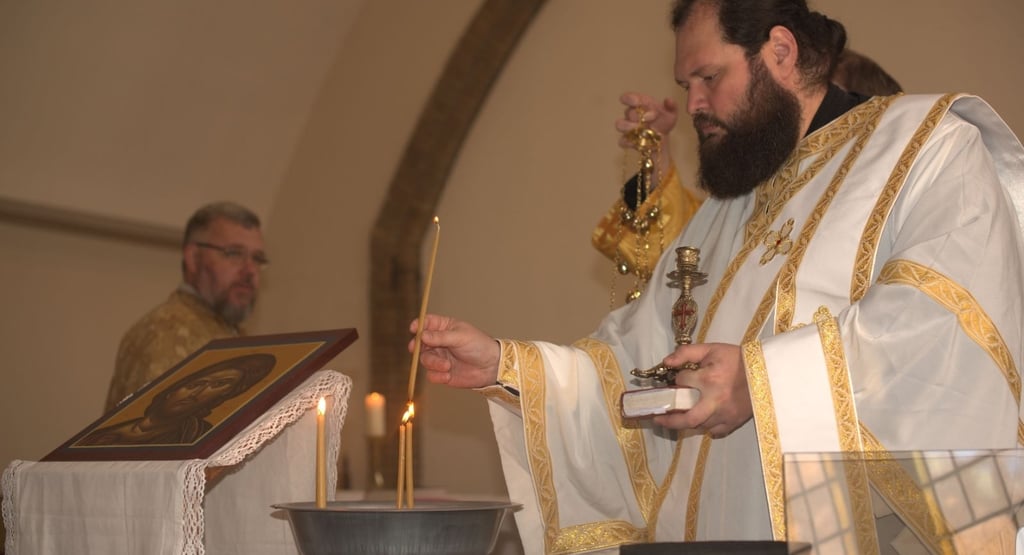
Create a prayerful environment: A peaceful space without TV or phone. Light a lamp or candle (optional but devout). Make the sign of the cross and begin with a brief opening prayer.
What Prayers to Read?
During the First 40 Days
Before reading the Psalter, the layperson typically prays:
“By the prayers of our holy fathers, Lord Jesus Christ, our God, have mercy on us.”
Amen.
Glory to You, our God, glory to You.
Heavenly King, Comforter, Spirit of Truth, who are everywhere present and fill all things; Treasury of good things and Giver of life, come and abide in us, cleanse us from every impurity, and save our souls, O Good One.
Holy God, Holy Mighty, Holy Immortal, have mercy on us (three times)
Glory to the Father and to the Son and to the Holy Spirit, now and ever and unto ages of ages. Amen.
Holy Trinity, have mercy on us; Lord, cleanse us of our sins; Master, pardon our transgressions; Holy One, visit and heal our infirmities for Your name’s sake.
Lord, have mercy. (three times)
Glory to the Father and to the Son and to the Holy Spirit… Amen.
Our Father… [the Lord’s Prayer]
Troparia in Tone 6 follow:
Have mercy on us, O Lord, have mercy on us, for we have no excuse, we sinners bring this prayer to You as Master, have mercy on us.
Glory to the Father and to the Son and to the Holy Spirit...
The glorious feast of Your Prophet, O Lord, is shown in heaven through the Church, and angels rejoice with people. By his prayers, Christ God, guide our lives in peace that we may sing to You: Alleluia.
Now and ever and unto ages of ages. Amen.
O Theotokos, the great multitude of my sins! I flee to you, O Pure One, asking for salvation. Look upon my soul in its weakness and pray to your Son and our God that He may forgive me for what I have done, you who are the only blessed—
Lord, have mercy (40 times). And bow as often as you can.
Most Holy Trinity, God and Creator of the whole universe! Strengthen and direct my heart to begin with understanding and complete the good works of these God-inspired books, which the Holy Spirit expressed through David’s words, because I wish to praise You by them. But knowing my weakness, I fall before You and ask: O Lord! Enlighten my mind and strengthen my heart so that I may not grow weary but may taste the delight of the holy songs, and so that I may learn good deeds through their words. Grant, Lord, that they may enlighten me so that I become a partaker of Your saints. And now, Master, bless me with my whole heart to sing to You:
“Come, let us worship the King our God” (bow).
“Come, let us worship and fall down before Christ our King and God” (bow).
“Come, let us worship and fall down before Christ Himself, our King and God” (bow).
Pause until you calm your thoughts, then read the kathismata.
After Each Kathisma
Read the memorial prayer for the newly departed:
“Remember, O Lord, our God, in faith and hope of eternal life the newly departed servant of Yours (name), and as Good and Lover of mankind, who forgives sins and destroys iniquity, lighten, remit, and forgive all their voluntary and involuntary trespasses, deliver them from eternal punishment and the fire of Gehenna, and grant them participation in Your eternal blessings, which You have prepared for those who love You. For You are the only true God and Lover of mankind; we believe in You. You are Resurrection and Life, and rest to Your servant (name), O Christ our God. To You we send up glory, together with Your eternal Father and the Holy Spirit, now and ever, and unto ages of ages. Amen.”
After reading the Psalter, pray:
Glory to the Father and to the Son and to the Holy Spirit, now and ever, and unto ages of ages. Amen.
Alleluia, alleluia, alleluia, glory to You, O God. (3x)
Lord, have mercy. (3x)
“With the saints give rest, O Christ, to the soul of Your departed servant (name), where there is neither sickness, nor sorrow, nor sighing, but life everlasting. For You are the Resurrection, the Life, and the repose of Your servant (name), Christ our God, and to You we send up glory with the eternal Father and the Holy Spirit, now and ever, and unto ages of ages. Amen.”
After 40 Days
You may read it daily or every other day after the first 40 days. The prayer is repeated after completing the kathisma, or read as a standalone.
“Rest, O Lord, the souls of Your servants (name), forgive all their sins, both voluntary and involuntary, grant them Your Heavenly Kingdom and make for them eternal memory.”
“Remember, O Lord our God, in faith and hope of eternal life the repose of Your servants (name), and as the Good and Lover of mankind who forgives sins and destroys iniquity, weaken, remit, and forgive all their offenses, voluntary and involuntary, deliver them from eternal torment and the fire of Gehenna, and grant them partaking and enjoyment of Your eternal blessings which You have prepared for those who love You. For though they have sinned, they did not depart from You, but surely believed in the Father, the Son, and the Holy Spirit… and the Trinity in Unity they confessed in Orthodox faith to their last breath. Therefore, be merciful to them, accept their faith in place of deeds, and with Your saints as the Bountiful One, give rest to them, for there is no one who lives and does not sin. For You alone are without any sin… and to You we send glory, to the Father, and to the Son, and to the Holy Spirit, now and ever, and unto ages of ages. Amen.”
Psalms for Various Needs
Besides reading the entire Psalter, Orthodox practice uses particularly powerful psalms for the departed:
Psalm 50 (a psalm of repentance)
Psalm 90 (for protection)
Psalm 118 (the longest, read at funerals)
Psalms 69, 102, 129 are also frequently read in prayers for the departed.
Posture & Inner Attitude
The Psalter contains words of anger and judgment against enemies. When reading for the departed, it’s important to maintain a humble, quiet, non-judgmental disposition—don’t read “against someone.” Also, don’t rush or read mechanically; read with awareness that every word is a prayer to God.
De Orthodoxe Parochie van de Geboorte van de Moeder Gods en de Heilige Adelbert
KvK 99887282 · RSIN 869173625
Oecumenisch Patriarchaat van Constantinopel
Contacts
priest: Andriy (Todosiychuk)
number: 06-23882565 (WhatsApp/ Telegram)
e-mail: fr.andriy@orthodox-alkmaar.nl
Our social media
Church Service Venues
©2026 The Orthodox Parish of the Nativity Theotokos in Alkmaar and Saint Adalbert of Egmond. All rights reserved.
Monastery of Saint Adalbert
Vennewatersweg 25, 1935 AR
Egmond-Binnen